
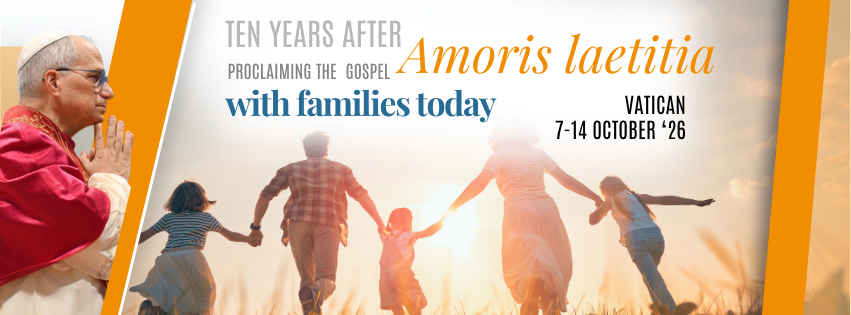
Ten years after Amoris laetitia: proclaiming the Gospel with families today
Meeting of the Holy Father Leo XIV with the Heads of Eastern Churches and the Presidents of Episcopal Conferences
7-14 October 2026
The PDF document is available in ENG - ESP - FRA - ITA - POR
Thematic Framework
The meeting of the Holy Father with the Heads of the Eastern Catholic Churches sui iuris and the Presidents of the Episcopal Conferences is intended to “to proceed, in mutual listening, to a synodal discernment on the steps to be taken in order to proclaim the Gospel to families today, in light of Amoris Laetitia and taking into account what is currently being done in the local Churches”[1]. It is therefore an eminently pastoral journey, situated within the ongoing process of “pastoral conversion”.
Along this journey, we are invited to ask the Lord “for the courage to persevere on this path”, opened by Amoris laetitia, “always welcoming the Gospel anew in the joy of being able to proclaim it to all”. Within this horizon, families are not merely recipients of the Church’s pastoral care, but active subjects of her mission, through whom the Gospel takes shape in daily relationships, choices, fragility and hope.
The days of reflection are intended to provide a genuine space for encounter, listening and discernment: welcoming the lived experiences of families; sharing concrete stories of life; reflecting on the initiatives of accompaniment that ecclesial communities, with the help of God’s grace, are putting into practice; and engaging in dialogue with experts. The aim is to discern the direction in which the Holy Spirit is leading us today, so as to recognize, support and foster what He is already accomplishing within families and to appreciate their contribution to the mission of the Church.
1. Families today: reality, beauty and challenges
Discerning the signs of the times through the experience of families and the Church’s pastoral commitment today
The starting point of the meeting is a gaze upon reality enlightened by the Gospel and rooted in Christ: “Our era is marked by rapid changes which make it necessary, even more than ten years ago, to give particular pastoral attention to families, to whom the Lord entrusts the task of participating in the Church’s mission of proclaiming and witnessing to the Gospel.” Following the path traced by Amoris laetitia, it becomes essential to appreciate “those signs of love which in some way reflect God’s own love”, accompanying persons “patiently and discreetly” (AL 294). This calls for attentive listening to the concrete lives of families and to the experience of those who accompany them, recognizing together both the beauty of love as it takes shape in daily life and the fragilities that often affect it, including precarious employment and housing, illness, the challenges of raising children, emotional loneliness, and the care of family members with disabilities, the elderly, or those who are not self-sufficient.
What signs of hope, what challenges and critical issues emerge today from family life in different cultural and social contexts? How do the transformations of our time affect the experience of love between man and woman, generation of life, care, the transmission of the faith, and the mission of the Church? Which pastoral experiences most effectively help to recognize God’s action in the concrete lives of families and to foster their human and spiritual resources? What are we learning from listening to families and from the experience of the local Churches? How can dialogue among lived experience, ecclesial discernment, theological research and the human sciences help us to deepen our understanding of the reality of families and to accompany them more effectively?
2. Young people and the discovery of the vocation to marriage
Listening to young people and accompanying them in discovering the value of marriage
In many parts of the world, young people live in contexts in which confidence in the possibility of building a stable marital and family project has weakened due to economic, social and cultural factors. Young people are searching for meaning, for witnesses – faithful and credible couples – and for persons capable of listening to them and helping them discover the beauty and promise of Christian marriage: “For this reason, the Church’s commitment […] must be renewed and deepened, so that […] young people may feel attracted, within the Church, to the beauty of the vocation to marriage.”
What language, experiences, and educational and spiritual pathways help children, adolescents and young people today to recognize the value of marriage? What witness can couples and families offer? How can they contribute to accompanying young people in their emotional, relational and sexual growth? What steps of pastoral attentiveness and conversion can help the Church accompany cohabiting couples in discerning their affective and family journey, as they mature in their choice of marriage and openness to welcoming children?
3. Married life. The first years of marriage: a decisive time
Listening to and accompanying couples in the early years of married life and at every stage of life
The experience of couples in the first years of married life calls for particular attention. This is an especially important phase for strengthening the marital bond and facing together the changes that accompany the beginning of family life, such as the birth of children and the challenge of balancing family and work, while discovering ever new meanings of conjugal and family love. It is a time in which spouses learn to reread their experience continually in the light of the Gospel, rooting their love in Christ and growing in freedom and mutual responsibility. Indeed, it is during these early years that many of the human and spiritual resources are cultivated that will help spouses navigate the different seasons of family life. “For this reason, the Church’s commitment […] must be renewed and deepened, so that those whom the Lord calls to marriage and family life can, in Christ, fully live out their conjugal love”, while also exploring ways to foster relationships of closeness among families, experiences of mutual support, and concrete forms of co-responsibility within the life of the ecclesial community.
What forms of accompaniment are most effective in supporting couples, particularly during the first years of married life? How can relationships of closeness among families, experiences of mutual support, and concrete forms of co-responsibility within the ecclesial community be fostered? How can spouses be helped to recognize and develop their relational, spiritual, generative and parental resources? Which experiences demonstrate the fruitfulness of networks of families capable of supporting one another and, in turn, becoming a source of accompaniment and witness for others?
4. In the difficulties of life: accompanying and supporting
Walking with families in complex situations
Particular attention is directed to couples and families who, at every stage of married life, encounter relational, social or spiritual difficulties, situations in which the Gospel is called to draw ever closer: “We must learn to evoke the beauty of the vocation to marriage precisely in the recognition of fragility, so as to reawaken ‘trust in God’s grace’ (AL 36) and the Christian desire for holiness. We must also support families, especially those suffering from the many forms of poverty and violence present in contemporary society.” Failure, fragility, the gap between the ideal and reality, and the complexity of life situations also become places in which the work of God’s grace may be recognized and where persons can be accompanied with respect, patience and hope.
What steps have been taken to support those living in situations of fragility or difficulty? What forms of resistance continue to emerge? How can Christian communities be built in which those who have experienced suffering, abandonment, separation and divorce may truly feel listened to, involved and co-responsible? Which concrete experiences already reveal today the face of a Church increasingly capable of proximity, discernment, accompaniment and appreciation, helping persons and families to regain confidence, recognize themselves as part of the community, and experience the mercy of God?
5. Christian families as subjects of the Church’s mission
Embracing conjugal and family love as an impetus for mission
In the words of Saint Paul VI, “married couples themselves by the leadership they offer […] become apostles to other married couples” (Humanae vitae, 26). They bear witness to the fact that love is not a static reality but a dynamic journey of continual self-giving: “We are not made for a life where everything is taken for granted and static, but for an existence that is constantly renewed through gift of self in love.” Spouses know well that one never ceases to learn the languages of love, day after day. Within Christian communities, couples have a distinctive way of responding to the common vocation to love. In a rapidly changing world, the contribution of families to the Church’s mission is more necessary than ever in fostering an “apprenticeship in enduring love”, with the benefits this brings to personal, ecclesial and social life. Despite the challenges posed by the pace of contemporary life, families remain the primary setting in which the faith is handed on to new generations (cf. AL 287). Their mission finds expression in many ways: in the daily witness of the Gospel, in accompanying other families, in participation in the life of Christian communities, and in the contribution they offer to society through experiences of love, care and solidarity.
How can the experience of couples and families be valued as a place of human, spiritual, ecclesial and social growth? How can a journey be fostered in which the couple’s relationship becomes a living experience of growth in faith and in social life? How can the contribution of families to the Church’s evangelizing mission and to the pastoral conversion of Christian communities be recognized and supported?
Vatican, 6 July 2026
[1] Unless otherwise indicated, quotations are taken from the Message of the Holy Father Leo XIV, published on 19 March 2026 on the occasion of the 10th anniversary of Amoris laetitia, by which he convoked the present Meeting.