

Publication of the Final Report of Study Group No. 5
Vatican, 10 March 2026
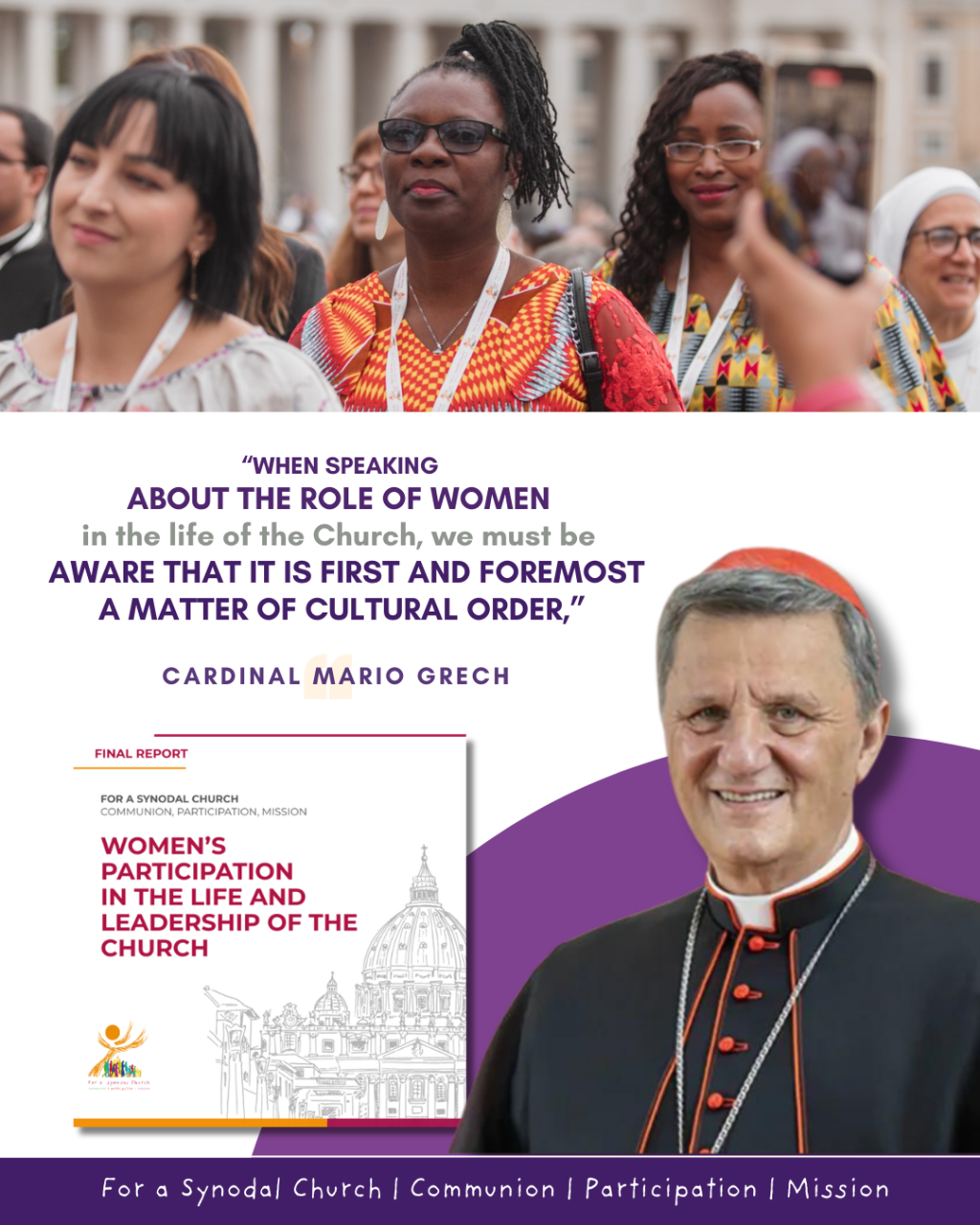
The General Secretariat of the Synod today publishes the Final Report of Study Group No. 5 on Women’s participation in the life and leadership of the Church.
“When speaking about the role of women in the life of the Church, we must be aware that it is first and foremost a matter of cultural order,” states Cardinal Mario Grech, Secretary General of the Synod. He continues: “In many parts of the world, there are in fact deep cultural challenges that must be acknowledged and addressed. Too often, the way faith is lived is determined by certain cultural aspects rather than by Gospel values. Our renewed mission is to make the Church a force that embodies the Gospel within cultures, promoting respect for the rights of all and co-responsibility according to each person’s vocation. This requires courage, accompaniment, and patience in introducing gradual changes in order to preserve ecclesial communion, eliminate discrimination, and build communities in which the gifts and charisms of every person, men and women alike, are valued.”
The Report
The Final Report is composed of three parts. The first offers a brief reconstruction of the history of Study Group No. 5 and its working method. The second part presents a reasoned synthesis of the themes that emerged from the synodal study. This section is the fruit of listening to the women consultors of the Dicastery, of the work carried out by its various bodies (Doctrinal Office, Congress, Feria IV), of the reading of the contributions received, and of numerous testimonies solicited by the Dicastery itself.
This section presents a reflection that begins “from below,” listening to the experiences and contributions of women who hold positions of responsibility in the Church, in order to discern what the Holy Spirit is accomplishing and inspiring. Among the key themes are: the recognition that the “question of women” constitutes a genuine sign of the times, through which the Holy Spirit himself is addressing the Church; a synodal attentiveness to the local Churches, with their cultures and their diverse and concrete contexts; a relational approach that highlights the charismatic dimension of women’s presence in ecclesial life; and an analysis of the concrete decisions made by Popes Francis and Leo XIV, whose choice to entrust women with positions of governance in the Roman Curia represents a model on which the entire Church is called to reflect.
Finally, the third part consists of an extensive appendix cataloguing the considerable body of material received and collected by the Dicastery, organized into six sections: 1) Female figures in the Old and New Testament; 2) Significant female figures in the history of the Church; 3) Contemporary testimonies of women participating in the leadership of the Church; 4) The Marian Principle and the Petrine Principle: a critical perspective; 5) Ecclesial potestas; 6) The contribution of Pope Francis and Pope Leo XIV on the role of women in the life and leadership of the Church.