

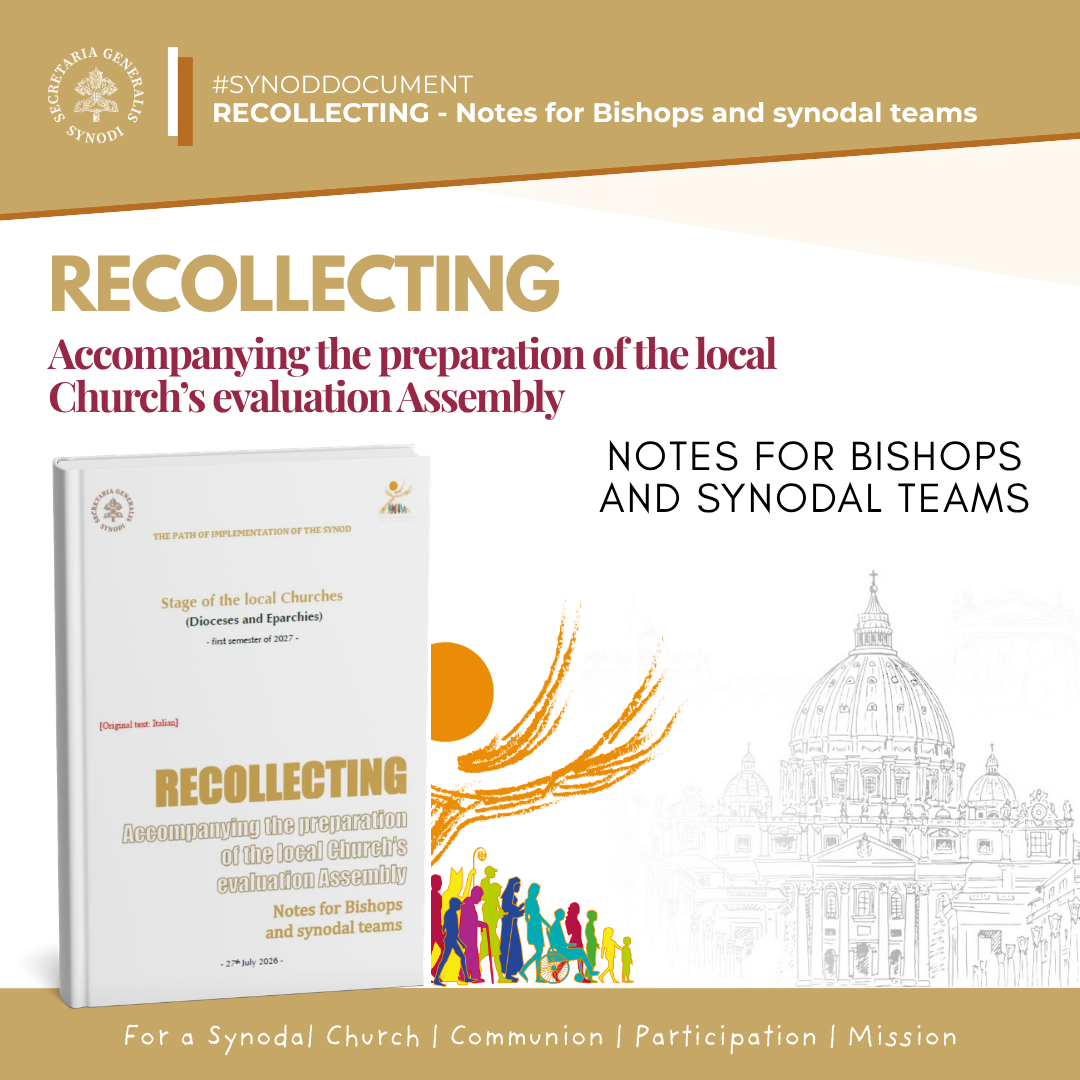
The General Secretariat of the Synod offers Bishops and synodal teams criteria and practical guidance for the 2027 stage
Vatican City, 27 July 2026
The General Secretariat of the Synod today publishes the Notes entitled “Recollecting”. Accompanying the preparation of the local Church’s evaluation Assembly. Available in several languages on synod.va, the document is intended to accompany the local Churches — Dioceses and Eparchies (the Dioceses of the Eastern Catholic Churches) — in preparing for and celebrating their own evaluation Assembly, to be held during the first semester of 2027, marking the culmination of the stage entitled “Recollecting”.
“Evaluation is not a technical exercise, but an experience of gratitude and truth. Recollecting means recognizing what the Lord has brought to maturity in the journey of our communities and allowing ourselves to be guided towards the next steps. This is how the Church becomes ever more capable of conversion.” — says cardinal Mario Grech, Secretary General of the Synod
What does “recollecting” mean
“Recollecting” denotes remembering, which in Scripture does not mean looking back to the past, but recognizing God's action in history in order to discern the present and open ourselves to the future. In this light, the Notes invite every local Church to prayerfully revisit with gratitude and sincerity the journey undertaken during the implementation phase of the Synod, so as to recognize the fruits that have matured and the further steps to which it is called. The document follows the principal reference texts of the synodal journey — the Final Document, the Pathways for the Implementation Phase (29 June 2025), and Towards the Assemblies 2027–2028 (20 May 2026) — providing practical guidance for the local stage of the process.
Recipients of the document
The Notes are addressed first and foremost to Bishops and Eparchs, who bear responsibility for the process, and to the synodal teams that animate it. Rather than proposing a model to be applied, they suggest a possible way of proceeding, offering questions, criteria and practical guidance to be adapted to each local context. They echo the words of Pope Leo XIV, who described synodality as “a spiritual style. It is born of encounter, grows through listening, and matures in discernment” (Address at the Conclusion of the Extraordinary Consistory, 27 June 2026).
The document
The document is divided into two closely connected parts. The first accompanies the drafting of the Narrative Report, the text through which each local Church recounts the journey it has undertaken. It is the fruit of a spiritual “rereading” in three movements — gathering the memory, recognizing and listening to the “signs”, and recognizing the processes of transformation — interpreted through the three forms of conversion identified in the Final Document: the conversion of relationships, ecclesial processes and bonds. The second part accompanies the preparation and conduct of the evaluation Assembly, convened by the Bishop as a “profoundly spiritual” experience. From it emerge both the Narrative Report in its definitive form and a Letter to the Other Churches. This letter recalls the litterae communionis — the “letters of communion” through which, in the early Church, each community bore witness to its faith before the others.
Responsibility and outcomes of the assemblies
The narrative report and the letter constitute the contribution that each local Church offers to the common journey of the Church as a whole, in the spirit of the “exchange of gifts”. Once approved by the Bishop, they will be transmitted to the national or regional synodal team and shared with the General Secretariat of the Synod by 30 June 2027.
Timeline
The evaluation Assemblies of Dioceses and Eparchies mark the beginning of a broader journey. They will be followed, during the second semester of 2027, by the Assemblies of the Episcopal Conferences and the Hierarchical Structures of the Eastern Catholic Churches; during the first four months of 2028, by the continental Assemblies; and finally, in October 2028, by the ecclesial Assembly in the Vatican, which will conclude the implementation process of the 2021-2028 Synod.