

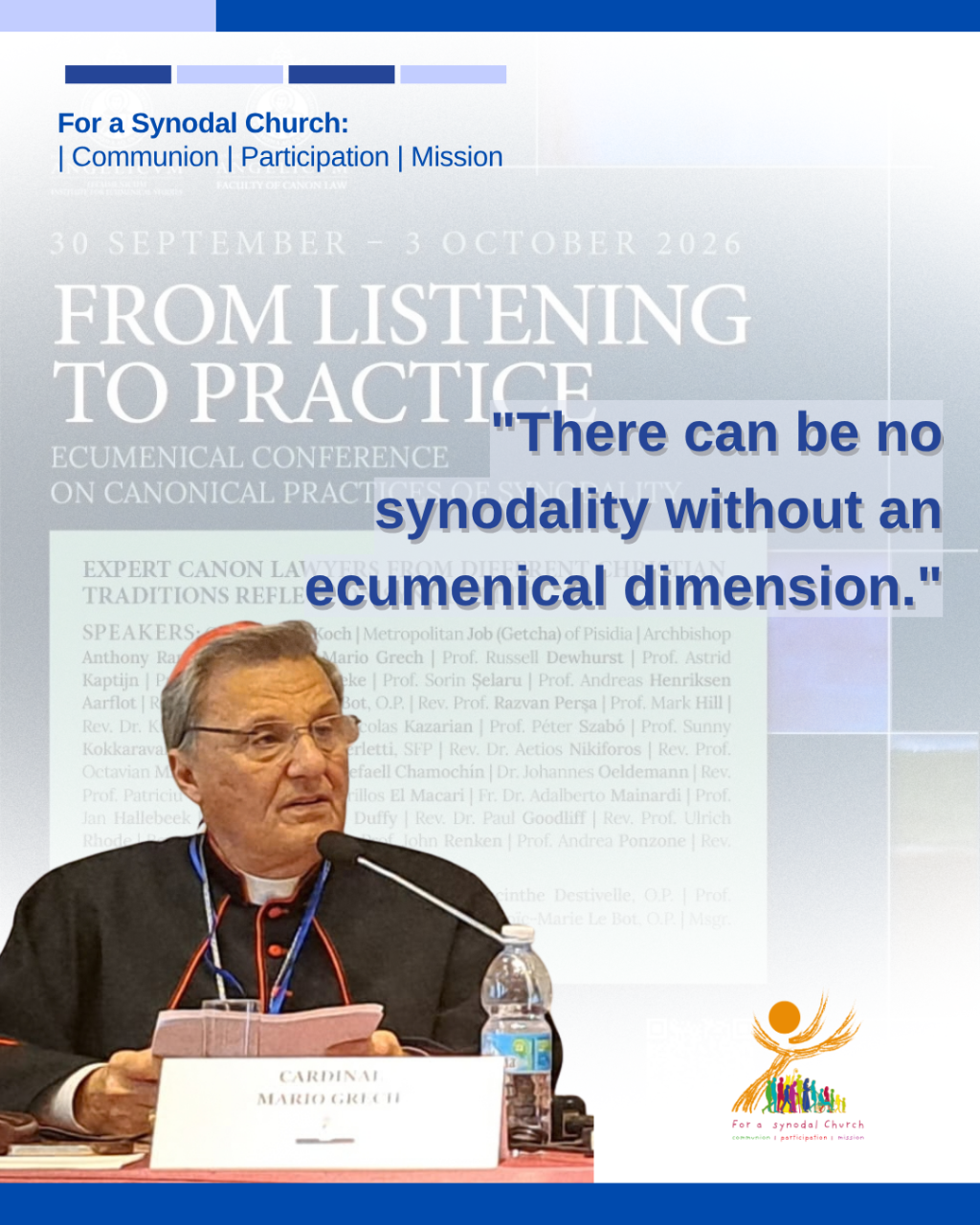
We present today the Keynote address of Cardinal Mario Grech held on September, 30 at the opening of the Seminar "From Listening to Practice Ecumenical Conference on Canonical Practices of Synodality" (30 September – 3 October 2026) at the Pontifical University of St. Thomas Aquinas (Angelicum) in Rome.
Introduction
Dear participants, I greet you all and am grateful to be with you for this conference. Our theme invites us to consider a question of great importance: how can canon law serve a Church growing in synodality and in communion with other Christians?
Since this address is intended as an introduction, I would like to approach that question by raising further questions rather than attempting to offer a comprehensive account. This seems more consistent with the attitude of listening which, according to both Pope Francis and Pope Leo XIV, is a defining characteristic of the Church’s synodal style. Well-formulated questions can guide our reflection from the outset and help us chart the path ahead. This, indeed, is one of the principal aims of this address.
As General Secretary of the Synod, I regard this conference as a valuable step in preparation for the Ecclesial Assembly of 2028. Therefore, in keeping with the listening phase, rather than offering immediate – and perhaps premature – answers regarding the role that canon law might play, from an ecumenical perspective, in a future and authentically synodal Church, I will raise a number of questions that seem central to our theme and that may help us deepen our reflection together.
Before moving forward, however, we need first to consider where we currently stand in the long process set in motion by the Second Vatican Council, particularly in the present effort to strengthen the synodal character of the Church. In this context, canon law clearly has an important role to play. At the same time, we need to discern the tasks and challenges that lie ahead.
With this in mind, I will divide my address into three parts: (1) ecumenism and synodality; (2) the role of canon law in the Church; and (3) the purpose of this conference and directions for the future.