
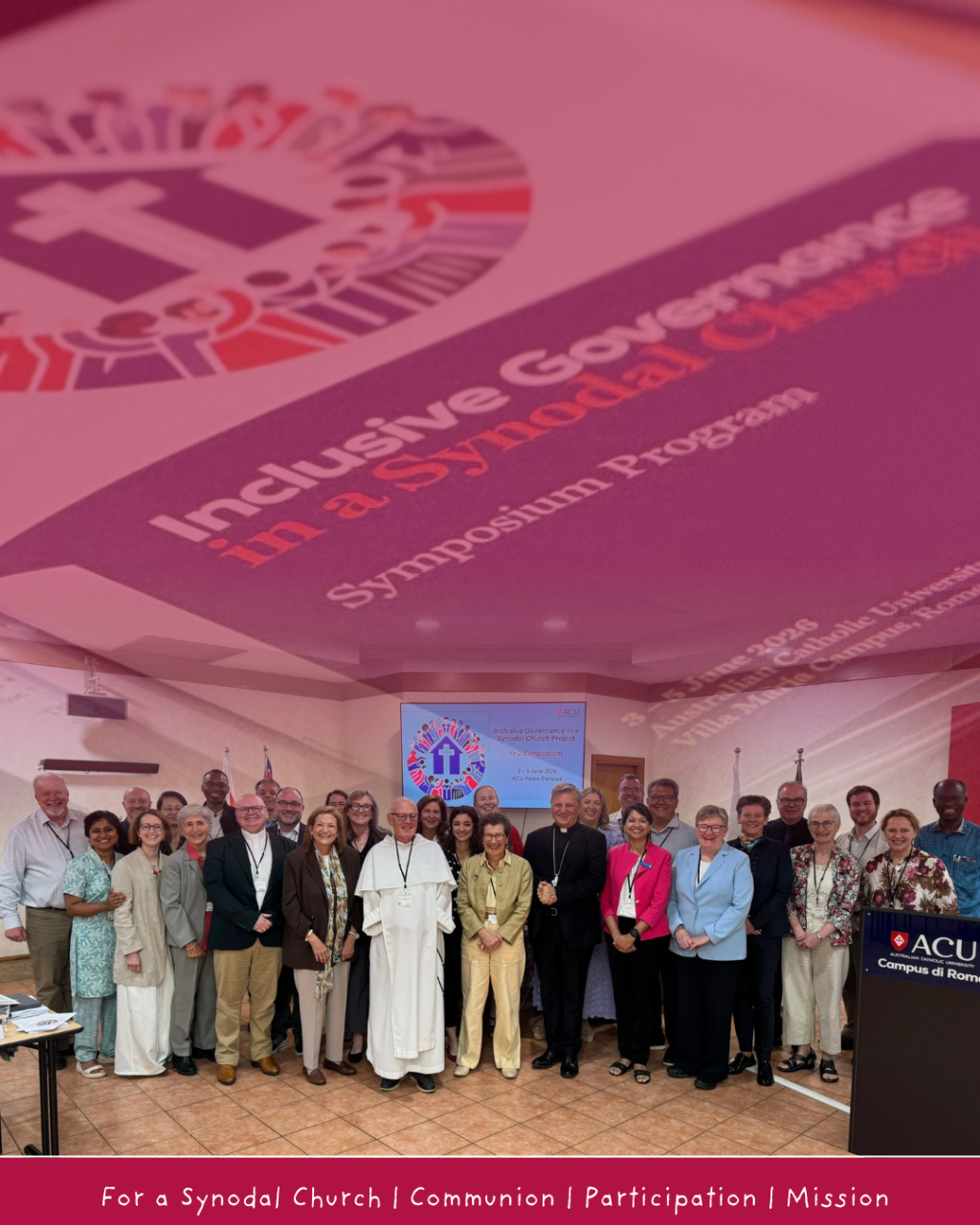
Address by Cardinal Mario Grech at the Second Symposium on “Inclusive Governance in a Synodal Church”
Rome, 3 June 2026
I am very pleased to be with you today and grateful for the invitation to open this Symposium on Inclusive Governance in a Synodal Church. My joy and gratitude spring from the awareness that a true, correct and resolute implementation of the processes of decision-making “in a synodal style, will further the progress of the People of God in a participatory way, especially by utilising the institutional means provided for in Canon Law, in particular participatory bodies” (Final Document, no. 94). This is especially true since the aim of this second symposium is to deepen reflection on the contribution and participation of the lay faithful in the governance of the Church.
It is within this awareness of synodal implementation that I would like, with humility, to offer a few focal points for your consideration during these days of reflection. As the Final Document states: “The way to promote a synodal Church is to foster as great a participation of all the People of God as possible in decision-making processes. If it is indeed true that the Church’s very way of living and operating is synodal, then this practice is essential to the Church’s mission, requiring discernment, the reaching of consensus, and decision-making through the use of the various structures and institutions of synodality.” (no. 87).
1. I fully share your choice of the key categories that shape your approach to the synodal implementation of lay participation in the governance of the Church: namely, the effective path of a synodal style of co-responsibility, sustained by the Paschal experience of inclusivity and by the conciliar commitment to implementation.
By making this choice, you place yourselves as interpreters within some of the most inspiring pages of the Second Vatican Council: co-responsibility is the mature expression of genuine participation in the life of the Church. It faithfully embodies that actuosa participatio which runs through all the Conciliar Constitutions – not only that on the Sacred Liturgy. It becomes a witness to an understanding of ecclesial life as a living contemporaneity with the Risen Christ, a dynamic path of discipleship, a shared responsibility for the transmission of the faith, and an authentic participation in the mission entrusted to us by the Risen One. It is the capacity to recognize and love Him amid the challenges of history, among the crucified of every age, discerning the signs of the times according to the measure of the Gospel.
Then there is the theme of inclusivity. How can we fail to relate this theological category to the action of the Spirit described in Gaudium et spes 22: “Christians conformed to the image of the Son, who is the first-born of many brothers and sisters, receive ‘the first fruits of the Spirit’ (Rm 8:23) which enable them to fulfil the new law of love. […] This applies not only to Christians but to all people of good will in whose hearts grace is secretly at work. Since Christ died for everyone, and since the ultimate calling of each of us comes from God and is therefore a universal one, we are obliged to hold that the holy Spirit offers everyone the possibility of sharing in this paschal mystery in a manner known to God”.
Inclusivity, therefore, is not simply an ecclesial strategy aimed at ensuring that everyone feels involved in processes of governance. It is, rather, is the path to being associated with Easter! It is our path to Easter. Inclusive choices are truly capable of offering fraternal hospitality to the Spirit’s Paschal action. The ecclesial community, constituted by the Risen Lord as a paschal fraternity, experiences and embodies, through the inclusive participation of the lay faithful in ecclesial governance, the closeness and active presence of both the Spirit and the Church.
Finally, there is implementation. The Council remains structurally open in its reception. Vatican II is, in this sense, an open Council. Your work of synodal implementation constitutes an authentic and fruitful reception of the Council. The Holy Spirit willed – and the Council Fathers understood –that this Council would not be handed on primarily through a system of canons and regulations, however necessary these may be. Rather, it would be entrusted as a leaven of consciousness and fraternity to the lived experience of the entire People of God, so that the People themselves might become, in the Spirit, the living subjects of the Council. This is the vision expressed in Lumen gentium 12 through the concepts of the sensus fidei and the consensus fidelium. It seems to me that today we are inhabiting these living pages of the Council: “The universal body of the faithful who have received the anointing of the holy one (cf 1 Jn 2:20 and 27), cannot be mistaken in belief. It displays this particular quality through a supernatural sense of the faith in the whole people when ‘from the bishops to the last of the faithful laity,’ it expresses the consent of all in matters of faith and morals. Through this sense of faith which is aroused and sustained by the Spirit of truth, the people of God, under the guidance of the sacred magisterium to which it is faithfully obedient, receives no longer the words of human beings but truly the word of God (cf. 1 Th 2:13); it adheres indefectibly to ‘the faith which was once for all delivered to the saints’ (Ju 3); it penetrates more deeply into that same faith through right judgment and applies it more fully to life.”
2. The Council has thus bequeathed to us, as an open and ever-developing inheritance along the paschal path of faith, a renewed understanding of the relationship between the laity and the hierarchy. Any synodal implementation of processes concerning the participation of the lay faithful in the governance of the Church must therefore take place within the reception of the Council’s ecclesiology of the People of God and engage seriously with the relationship between laity and hierarchy.
As the Final Document states: “In a synodal Church, the authority of the Bishop, of the Episcopal College and of the Bishop of Rome in regard to decision-taking is inviolable as it is grounded in the hierarchical structure of the Church established by Christ; it both serves unity and legitimate diversity (cf. LG 13). Such an exercise of authority, however, is not without limits: it may not ignore a direction which emerges through proper discernment within a consultative process, especially if this is done by participatory bodies. It is not appropriate to set the consultative and deliberative elements involved in reaching a decision in opposition to each other: in the Church, the deliberative element is undertaken with the help of all and never without those whose pastoral governance allows them to take a decision by virtue of their office.” (no. 92). The synodal implementation of those synodal processes that contribute to the progress of the People of God from a participatory perspective is therefore called to grapple with this genuine conciliar challenge. It is a challenge of renewal, reform, change, and conversion. Above all, it is a challenge of fidelity to the action of the Holy Spirit. At its heart lies the “of all” that characterizes authentic discernment.
Discernment is a category that, until recently, was often confined to the sphere of personal and spiritual experience. The Synod has restored it to us as an authentic pneumatological dynamic of governance and co-responsibility. Discernment is a is a pneumatological space; it is the guarantee of the Spirit’s presence and activity in and for the life of the Church. The question, therefore, is not to determine who should command and who should decide. We cannot live the Church – not merely within the Church – according to the logic of the princes (rulers) of this world. The issue is not the democratization of decision-making processes. Rather, it is the shared search for the will of God; it is learning together to become artisans and co-workers in the work of salvation; it is making synodality an effective force for communion. Communion – not power – is the true measure of hierarchy! Co-operation in the work of salvation – not democracy – is the true measure of discernment!
The Church is not a political structure but a structure of grace. Her presence within the polis, among the homes and lives of women and men, is lived as charity and prophecy. As a structure of grace, as the universal sacrament of salvation, the Church is intrinsically open. Like the Council itself, she remains open to the eschatological fulfilment of history in charity and to the presence, here and now among us, of the Kingdom of God.
3. Finally, I would like to offer a theological reflection rooted in our baptismal identity – not as a concluded argument, but as an open invitation for further reflection. The Synod has given us all an eschatological and charitable imperative: not to allow ourselves to be imprisoned by closed ways of thinking. The salvation of which the Church is the universal sacrament is a hospitable design, not an exhausted message!
The time has come to view (pastoral) charity as the entire mission entrusted by the Risen Lord to the People of God, so that Christ may be encountered in the wounds of crucified humanity and in the darker folds of history. The human person is, as it were, a great vertical wound. It is a matter of reaching Christ, rather than bringing him, who is truly present in situations of poverty and marginalisation. Poverty and marginalization are those places where the Incarnation continues as a salvific process of assumption. Each time, He becomes that poor person; each time, the Spirit inhabits that marginality as His own dwelling place. How beautiful it would be if charity were to mature as the theological virtue of a people willing to become the other whenever that other is poor or marginalized. This is the universality of salvation understood as a shared theological co-operation. It is fraternity becoming the place where totality is realized. Charity impels us toward the whole, toward the “for all” of the Church’s mission, with fraternity serving as the measure of the universal.
Theological hope, for its part, is born from participation in the prophetic mission of Christ. It thus becomes a shared work of redemption, of restoring dignity, of fostering processes of justice and truth, and of drawing close to the least and the crucified. Hope is the theological dwelling of the entire People of God within the history of humanity and of our common home. The time has come to read history in the evangelical light of the signs of the times. We are called to contemplate history – every moment of our contemporaneity, every expression of our present age – through the theological lens of charity, so as to discern within it the path of the Risen Lord’s return among us and to keep our lamps burning with the oil of justice and truth. Light from Light! This phrase of the Creed possesses a theological depth that is not only Christological and Trinitarian. It should also be understood in relation to the prophetic bond between Christ and the whole body of the faithful. Such an understanding will lead us toward a mode of presence in history that is entirely ministerial, where lay ministries become expressions of discernment of the signs of the times and assume, within the concrete life of local Churches, the baptismal mission of co-operating in the work of salvation.
How, then, are we to look at faith today, in a context where its transmission has become an epochal challenge? How are we to live synodally the sensus fidei of the entire People of God? It seems to me that we can once again turn to Pope Francis’ Evangelii gaudium, where he presents intercession as a task and ministry entrusted to the whole People of God. Faith today can be understood as a form of intercession exercised by the People of God. Yet this intercession springs from one of the most beautiful and striking scenes of the Gospel: Jesus allowing Himself to be baptized by John. He places Himself among sinners as one of them and for them. Jesus is not a sinner, yet He stands among sinners so that His flesh may become their – our – salvation. It is an intercession of salvation accomplished in the flesh. It is this intercession of flesh and faith that I wish to propose to you.
We stand among all as one with all. Yet our baptismal flesh – our history, our conscience, our freedom – enables us through faith to place ourselves among all as a presence of forgiveness, justice, freedom, dignity, and goodness; as a path of reconciliation and rebirth. Our baptismal flesh, in the manner of the Incarnation, is capable of becoming a way of salvation. This is the intercession I have in mind. The martyr for justice among humanity, Dietrich Bonhoeffer, understood this form of intercession in terms of vicarious representative action: a Christ-like posture assumed by the disciple in every circumstance. Faith as a theological virtue, understood as intercession, carries us even to martyrdom. It makes us ready to take the place of the innocent victim or even of the sinner. It impels us to allow God, who is Charity, to find us in the flesh of the least, in that condition of ultimate vulnerability born of and enslaved by sin. It makes us neighbours to all those who still fall into the hands of robbers. Do you remember the words of St Paul? “Indeed, only with difficulty does one die for a just person, though perhaps for a good person one might even find courage to die. But God proves his love for us in that while we were still sinners Christ died for us.” (Rom 5:7-8). Through faith, we become the flesh of the least. This is our participation, from below, in the work of salvation; this is our co-operation in God’s saving plan.
Allow me, then, to conclude with a brief passage from the beautiful Letter to Diognetus, dating from the second century:
Christians are indistinguishable from other men either by nationality, language or customs. They do not inhabit separate cities of their own, or speak a strange dialect, or follow some outlandish way of life. Their teaching is not based upon reveries inspired by the curiosity of men. Unlike some other people, they champion no purely human doctrine. With regard to dress, food and manner of life in general, they follow the customs of whatever city they happen to be living in, whether it is Greek or foreign. And yet there is something extraordinary about their lives. They live in their own countries as though they were only passing through. They play their full role as citizens, but labor under all the disabilities of aliens. Any country can be their homeland, but for them their homeland, wherever it may be, is a foreign country. Like others, they marry and have children, but they do not expose them. They share their meals, but not their wives. They live in the flesh, but they are not governed by the desires of the flesh. They pass their days upon earth, but they are citizens of heaven. Obedient to the laws, they yet live on a level that transcends the law. Christians love all men, but all men persecute them. Condemned because they are not understood, they are put to death, but raised to life again. They live in poverty, but enrich many; they are totally destitute, but possess an abundance of everything. They suffer dishonor, but that is their glory. They are defamed, but vindicated. A blessing is their answer to abuse, deference their response to insult. For the good they do they receive the punishment of malefactors, but even then they, rejoice, as though receiving the gift of life. They are attacked by the Jews as aliens, they are persecuted by the Greeks, yet no one can explain the reason for this hatred. To speak in general terms, we may say that the Christian is to the world what the soul is to the body.
This is who we are – all of us.