
The first two days of the Meeting "Ten years after Amoris laetitia: proclaiming the Gospel with families today," (Vatican, 7-14 October 2026)
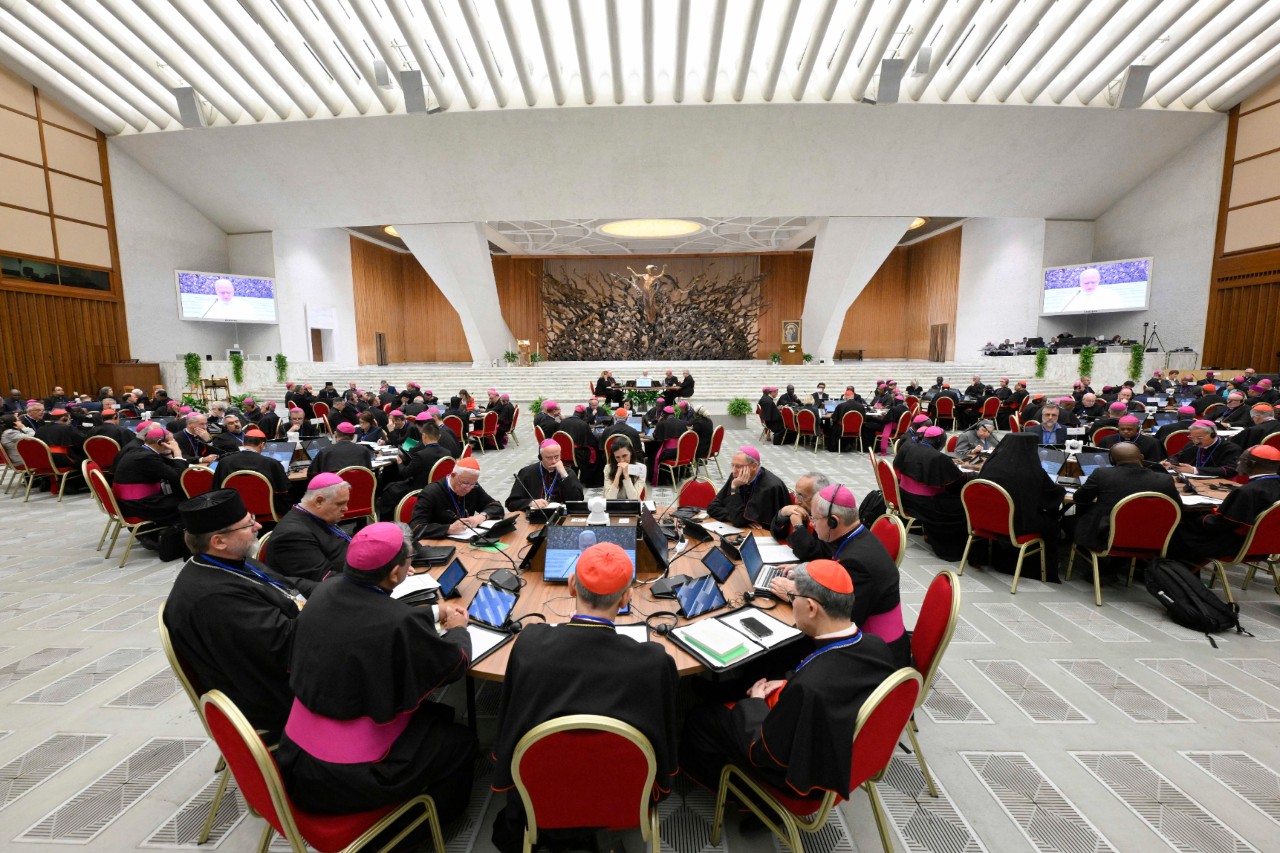
The Meeting that gathers the Heads of the Eastern Catholic Churches and the Presidents of the Episcopal Conferences, ten years after Amoris laetitia, opened on the afternoon of Wednesday 7 October with an encounter with Pope Leo XIV in the Paul VI Hall.
Welcoming the participants, Cardinal Mario Grech, Secretary General of the Synod, underlined the deep ecclesial significance of the gathering. Those present, he noted, have come “not in a personal capacity but as representatives of their episcopates and, through them, of the local Churches that are the lifeblood of the universal Church”, carrying with them the hopes, challenges, joys and concerns of countless families. A great responsibility, he observed, yet one that awakens an equally great hope: responsibility calls the Church to fidelity, listening and discernment, while hope opens it to the action of the Holy Spirit, who continues to guide the Church along the paths of its mission.
Cardinal Kevin Farrell, Prefect of the Dicastery for Laity, Family and Life, then addressed the Holy Father, recalling that the time has come “to reflect on the journey undertaken in the local Churches, to look ahead to the challenges that await us, and to ask ourselves what might make the proclamation of the Gospel more relevant to families so that they may rediscover and live out their Christian vocation with greater awareness”. He pointed to a decade of rapid cultural and social transformation, marked by secularisation, individualism, the pervasiveness of technology and the weakening transmission of faith within families, alongside a renewed desire for authentic and lasting relationships. Catechesis remains indispensable, he said, but can no longer on its own sustain the transmission of faith among the younger generations: building strong and authentically Christian families is the prerequisite for a Church that is alive and firmly rooted in the Gospel.
At the heart of the session was the address of Pope Leo XIV. Retracing the Church's synodal path on marriage and the family, from the Second Vatican Council through Familiaris consortio to Amoris laetitia, the Holy Father invited the participants to share what God has done in their communities over these ten years, including conversions, unexpected fruits and difficulties, so that “a shared narrative of these ten years may gradually take shape”. Families, he recalled, are not only recipients of the Church's care but active protagonists of its mission, through love, fidelity, forgiveness, the education of children, the transmission of faith and service to the most vulnerable: it is through the lay faithful, and especially through families, that the Church can become the salt of the earth.
The Pope described pastoral ministry as a “school of listening,” in which the Church has much to learn from families themselves. He did not shy away from the difficult questions: the growing distance between contemporary relational and affective life and the Christian vision of marriage, and the pressures of economic insecurity, migration, violence and loneliness. Above all, he invited the assembly to ask what kind of Church people encounter precisely when they are most fragile, and whether the truth of the Gospel can be met through patience, closeness and mercy. Fidelity itself, he suggested, “is a grace to be received and a path renewed” step by step, often through trial: “we need grace, forgiveness and new beginnings to accomplish God's will”. He urged pastors to let the realities of family life question them, and not merely to interpret them, so that the Church may find new ways to proclaim the Gospel and to offer the grace of the sacraments, praying that it may become “ever more fully good news for families throughout the world.”
A spiritual meditation by Sr Helen Alford, O.P., closed the opening session, developing the theme of the Gospel of and to the family: families both proclaim the Good News and need to receive it. She opened with the words of a small child who, asked where God is, answered “God is here, with us”. The younger generations, she suggested, proclaiming the Gospel of the family to us. Taking the encounter between Jesus and the Samaritan woman as a paradigm of evangelisation, she showed how beauty and fragility coexist: it is precisely from within her fragile situation that the woman becomes the first public evangelist. Through the “relational gaze” of Jesus, she observed, the hidden relationships that make up family life become visible, something of fundamental importance if young people today are to find the courage to enter marriage and the strength to sustain it. Recalling the “law of gradualness” that links Familiaris consortio and Amoris laetitia, she left the assembly with three questions for the days ahead: where can we recognise God already at work in the lives of families; what can we learn from families in their beauty and their fragility; and how can we proclaim the Gospel not only to families, but with them.
The opening session set the tone for the entire meeting: a Church that listens before it speaks, that honours both the beauty and the fragility of family life, and that recognises families as true protagonists of the proclamation of the Gospel.
Then, the first full day of the Meeting, Thursday 8 Ocotober, was devoted to the first of its five themes: "Families today: reality, beauty and challenges." The day unfolded as a shared exercise in listening, discernment and the exchange of concrete experiences from local Churches around the world.
Opening the proceedings, Cardinal Kevin Farrell, set the horizon for the work: to reflect together, in the light of the Gospel, on the cultural, economic and social context in which family ministry takes place, with attention to its spiritual implications for people's lives. He invited participants to share concrete examples and to take an honest look at the resources their local Churches have for reaching out to families, understanding their daily lives and walking alongside them.
Cardinal Mario Grech, Secretary General of the Synod, introduced the day through the image of the “echo”, the sign that a voice has travelled, found a receptive space and returned enriched. He identified three echoes to which the assembly is called to listen: the echo of the Gospel, the foundational voice of all pastoral care; the echo of the Magisterium, and of Amoris laetitia, whose reception over ten years has borne fruit but also raised tensions and open questions; and the echo of the voices of families themselves, who reach the Church not as statistics but through concrete lives in which faithfulness and fragility are often intertwined. Families, he recalled, are subjects of the Church's mission, and the Church has much to receive and learn from them.
Then Cardinal Filipe Neri Ferrão offered a view from the local Churches of Asia. He traced three profound shifts — in the identity and composition of the family, from rootedness to mobility, and in families' existential conditions amid rapid but unequal growth — while highlighting the beauty of grace at work in the ordinary: the beauty of relationship, of resilience and hope, and of dialogue amid immense religious and cultural diversity. His central conviction: families are not merely receivers of care but the Church's partners in mission, and the Gospel is a reality that “comes alive” from within family life itself.
The last input of the morning was given by Prof. Vincenzo Rosito, who read family and Church as relational realities that learn from one another through the practices of everyday life. Anthropological and cultural changes, he argued, are not only problems to be solved but human activities and opportunities for a shared learning that involves the whole People of God. Rereading the Gospel episode of the Flight into Egypt through three words — mobility, violence and dream — he pointed to communities that, drawing on the experience of migrant and refugee families, are becoming “refuge churches”, imagining new forms of pastoral care through concrete, daily gestures of welcome.
Across these contributions, a common thread emerged: a Church that chooses to listen before it speaks, that reads cultural and social change as an invitation to conversion, and that increasingly recognises families not as objects of pastoral concern but as protagonists of the Gospel and enduring places of God's revelation.
The rest of the morning was devoted to group work, using the ‘Conversation in the Spirit’ method. In the afternoon, there was time for open discussion amongst the participants following the presentation of the group work results by the rapporteurs.
Friday 9 October, the third day of the meeting, will be devoted to the theme ‘Young people and the discovery of their vocation to marriage’. At 1.30 pm (Rome time), a briefing on the proceedings of the assembly will take place at the Holy See Press Office.