as forms of effective collaboration in assisting the Holy Father
Address by the Secretary General of the General Secretariat of the Synod delivered on 8 January 2026 during the Extraordinary Consistory.
In order to illustrate how the Synod and synodality constitute effective forms of collaboration with the Petrine ministry in its task of discernment, I wish to propose a few reflections drawn from the experience of the XVI Ordinary General Assembly of the Synod of Bishops, on the theme “For a Synodal Church: communion, participation, mission.”
The word “mission” appears last not because it is less important, but because it naturally pushes outward, ad extra, prompting us to see how a truly synodal Church is also a missionary one. Mission is not optional or secondary; it is the natural overflow of ecclesial life when lived in mutual listening, communal discernment, and shared responsibility.
From this perspective, synodality is inherently missionary, and likewise mission is always synodal, since proclaiming the Gospel is never an individual effort but an ecclesial act, sustained by communion and directed toward building the Kingdom. “Synodality is the walking together of Christians with Christ and towards God’s kingdom, in union with all humanity” (FD 28).
The journey undertaken during the XVI Ordinary General Assembly of the Synod of Bishops has made it possible, through the various stages of the synodal process, to highlight the different levels at which synodality is exercised.
The first level involved the whole Church, through the consultation of the People of God in the local/particular Churches, engaging each diocesan Bishop as well, as the “principle and foundation of unity” in his particular Church (LG 23).
The second level took place within groupings of Churches: the contributions of the local Churches were forwarded to the Episcopal Conferences, which prepared syntheses that converged in the Document for the Continental Stage, on which the seven Continental Assemblies worked.
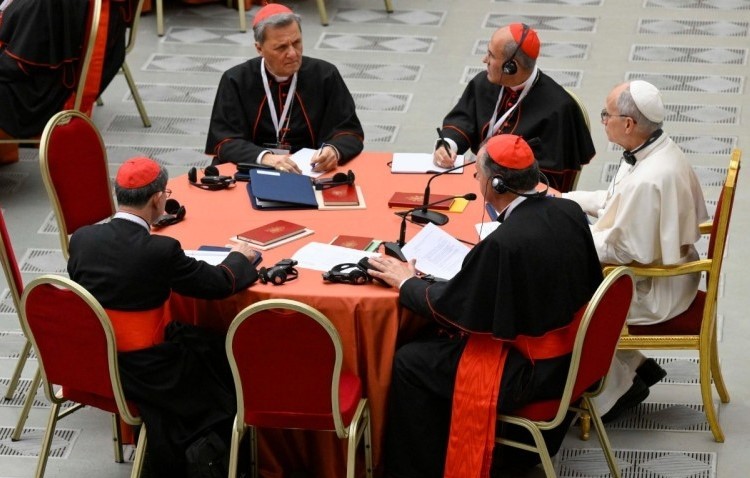
The third level was realised through the celebration of the Assembly of the Synod of Bishops in two sessions, in October 2023 and October 2024. The Instrumentum laboris for the first session gathered the results of the listening process, on which the Assembly reached broad consensus, expressed in the Synthesis Report. Following a further consultation, the Instrumentum laboris for the second session was prepared, which concluded with the vote on the Final Document. Pope Francis recognised this document as the fruit of the ecclesial discernment process and returned it to the Church so that the process of reception might begin.
From this experience, I would therefore like to offer some contributions for our meeting:
The first contribution points towards a deeper understanding of the primacy. It always belongs to the Bishop of Rome to convoke, accompany, conclude and – if necessary – suspend the synodal process. In no way do the Synod of Bishops and the exercise of synodality limit the exercise of the primacy; rather, as in the case of collegiality, they confirm the “teaching about the institution, the perpetuity, the meaning and reason for the sacred primacy” (LG 18). The dynamic of the synodal process confirms that the Bishop of Rome is the principle of unity of the whole Church, insofar as he is the principle of unity of the holy People of God (communio Fidelium), of the “Mystical Body, which is also the body of the Churches” (LG 23) (communio Ecclesiarum), and of the Episcopal College (communio Episcoporum). This is a contribution that the Final Document entrusts to the Church (cf. FD, no. 18).
The second contribution emerges from the very celebration of the Synod. The synodal process unfolds through a joint exercise of the prophetic function of the People of God and the discernment function of the Pastors, grounded respectively in the common priesthood and in the ministerial priesthood, which are “interrelated: each of them in its own special way is a participation in the one priesthood of Christ.” (LG 10). By virtue of this circular relationship between the sensus fidei of the People of God and the magisterium of the Pastors, the synodal process can offer the Bishop of Rome a consensus around the matter under consideration – a consensus that has always been of great value in the Church for discerning “what the Spirit is saying to the Church.”
The third contribution is suggested by the levels of exercise of synodality described above. If the synodal process includes the consultation of the People of God in the particular Churches, the discernment of the Pastors within the Episcopal Conferences and Continental Assemblies, and the celebration of the Synod of Bishops in Rome, it is possible to envisage an exercise of synodality at multiple levels, with differentiated involvement of subjects according to the issues to be addressed:
- a synodal process involving the whole Church and all in the Church, as provided for by Episcopalis Communio;
- consultation of the Bishops as “principle of unity in their particular Churches” (LG 23), as occurred in the case of the Marian dogmas and in the preparation of the themes to be addressed by the Council;
- consultation of the Episcopal Conferences, in an exercise of collegiality that recognises them as subjects of pastoral discernment, as envisaged by PE I/5–7. In this regard, a periodic meeting of the Holy Father with the Presidents of the Episcopal Conferences would be beneficial, as well as greater promotion of international reunions among Episcopal Conferences (CCEE, SECAM, FABC, FCBCO, SECAM).
- study groups composed of Bishops and experts from around the world, members and non-members of the Roman Curia, to address specific questions entrusted to them by the Holy Father – true workshops of synodality;
- consultation of the bodies of the universal Church, in particular the College of Cardinals, who act collegially “when they are convoked to deal with questions of major importance” (CIC, can. 349).
It is not necessary that these forms of exercising synodality always be expressed institutionally through the convocation of a Synodal Assembly. Synodality can also be exercised in an informal manner, through which the Pope undertakes consultation prior to making a decision (either directly or through the competent bodies: the General Secretariat of the Synod for “matters of major importance for the good of the whole Church” (PE 33), or the Dicasteries of the Roman Curia for matters within their specific competence).
Within this framework, the Synod constitutes a significant institution of the Catholic Church. According to Praedicate Evangelium, this body “collaborates with the Roman Pontiff, in accordance with the methods established or to be established by him, in matters of major importance for the good of the whole Church” (PE 33).
The orderly exercise of synodality already shows its fruits:
- the participation of all subjects – the People of God, the College of Bishops, the Bishop of Rome – in the life and mission of the Church, with a clear impact on missionary dynamism;
- the strengthening of relationships between the People of God and their Pastors, and between the College of Bishops and the Bishop of Rome;
- the concrete realisation of the relationship of mutual interiority between the universal Church and the particular Churches, which grounds and regulates the entire synodal process;
- the reaffirmation of the centrality of the Bishop of Rome as the principle of unity of all the baptized, of all the Churches, and of all the Bishops, to whom it belongs to call the Church to synodal action.
We are thus called to ask ourselves: how can synodality be made the style of the Church, and the Synod of Bishops an ever more fitting body to promote “this life of communion [which] makes the Church synodal; a Church marked by reciprocal listening, “whereby everyone has something to learn. The faithful people, the College of Bishops, the Bishop of Rome: all listening to each other and all listening to the Holy Spirit, the Spirit of truth (cf. Jn 14:17), in order to know what he says to the Churches (cf. Rev 2:7)”” (PE 4)?
Mario Card. Grech
Secretary General