
Publication of the Final Report of the Canonical Commission
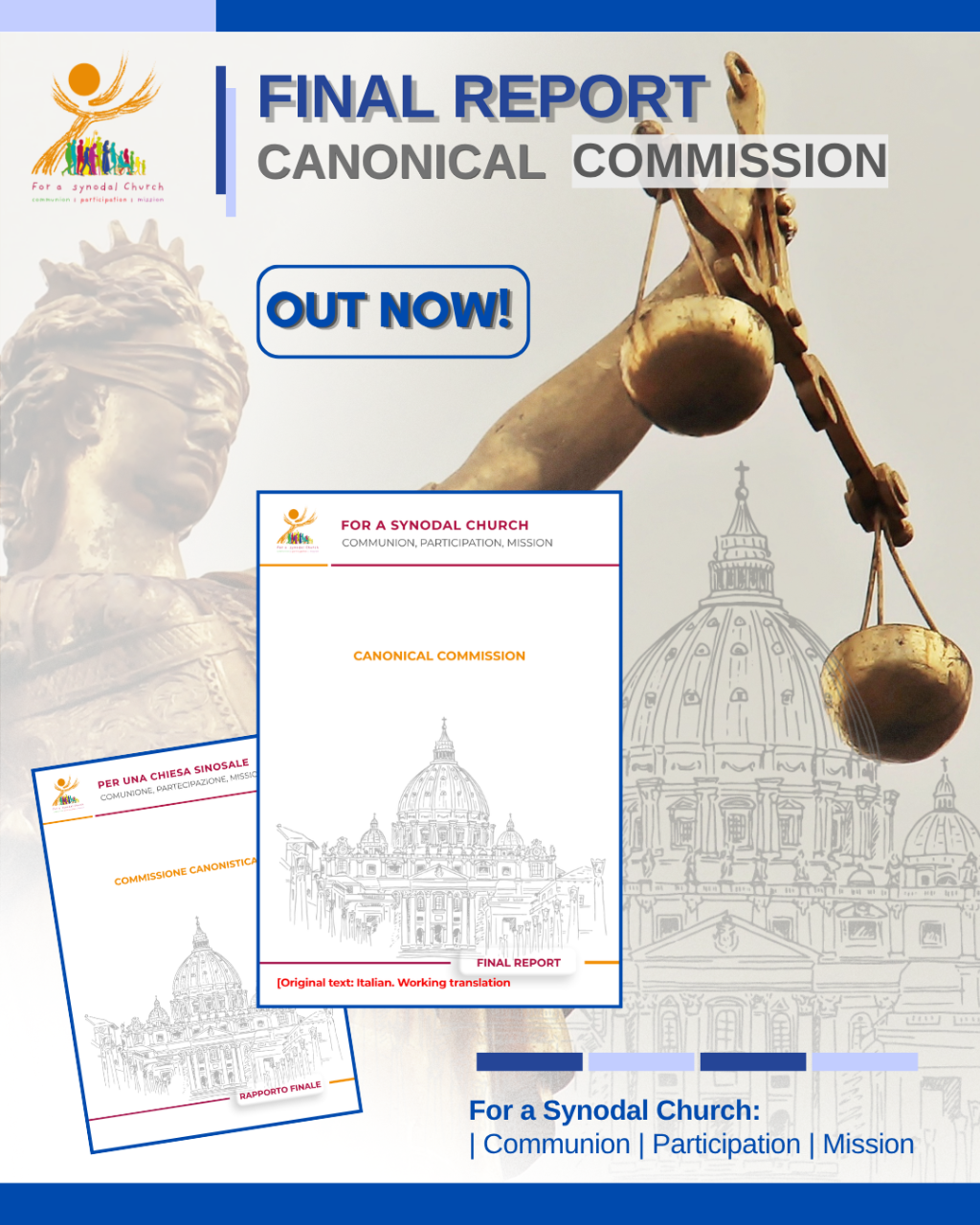
The General Secretariat of the Synod today publishes the Final Report of the Canonical Commission.
The Canonical Commission – established in service of the Synod, in agreement with the Dicastery for Legislative Texts, in accordance with the provisions set forth during the Audience granted by Pope Francis on 18 December 2023 – has worked over these years on the basis of the results of the 2021-2024 synodal process, particularly the Final Document approved on 26 October 2024, as well as the various contributions received from experts throughout the world.
As stated in the introduction to the Final Report, the Commission sought to identify the ways in which the theological and ecclesiological insights emerging from the synodal process may be translated into canonical norms, distinguishing three temporal timeframes. In the short term, it proposes specific amendments to the current legislation capable of immediately supporting ecclesial life in its concrete unfolding: these constitute the subject of the present Report.
Without entering into specifics, the Commission also identifies certain areas which, arising from synodal needs, may be addressed in the medium term, in a transversal manner and in collaboration with the competent Dicasteries, through the issuance of new Instructions or the revision of those already in force. Finally, in the long term, it envisages the need for a comprehensive revision of both Codes of Canon Law – the Latin and the Eastern – so that they may adequately incorporate the theological and ecclesiological developments that have emerged.
“While the whole Church is engaged in theological and ecclesiological reflection on her synodal nature, it seemed important to initiate a corresponding reflection on the norms – the canons – that govern her organisation and the relationships among her members. Canon law, in fact, is the juridical expression of what, in every age, the Church perceives about herself and about that which constitutes the object of her faith, together with the consequences this entails for the way human relationships are lived within her. The same reflection will also extend to the law of the Eastern Catholic Churches, for which a specific commission has recently been established. Without corresponding canon law, theology would remain incomplete, ‘like a man with only one arm’,[1] as Pope Leo XIII once recalled,” states Cardinal Mario Grech, Secretary General of the Synod.
The proposed amendments
The first part of the document contains proposals to amend the canons of the Code concerning the possibility for the lay faithful, both men and women, to exercise in the Church those offices, functions and ministries for which they are suitably qualified and competent, including within the sphere of ecclesial governance.
The second part proposes the revision, from a synodal perspective, of certain canons concerning Particular Councils and Episcopal Conferences, namely those ecclesial bodies entrusted with fostering collaboration among the local Churches.
Finally, the third part addresses participatory bodies as already established in the Code, while proposing amendments aimed at strengthening their participatory dimension and missionary orientation.
Like the Final Reports of the Study Groups, the present Report is to be considered a working document.
***********
[1] Cfr. Leo XIII, Encyclical letter Depuis le jour to the archbishops, bishops and clergy of France, 8 September 1899.
***********
To the Final Report
To the News Release in FRA and POR