
The third and fourth days of the Meeting “Ten years after Amoris laetitia: proclaiming the Gospel with families today” (Vatican, 7-14 October 2026)
The third and fourth days of the Meeting that gathers the Heads of the Eastern Catholic Churches and the Presidents of the Episcopal Conferences were devoted to two closely linked themes: the discovery of the vocation to marriage among young people, and the first, decisive years of married life.
Friday 9 October — Young people and the discovery of the vocation to marriage
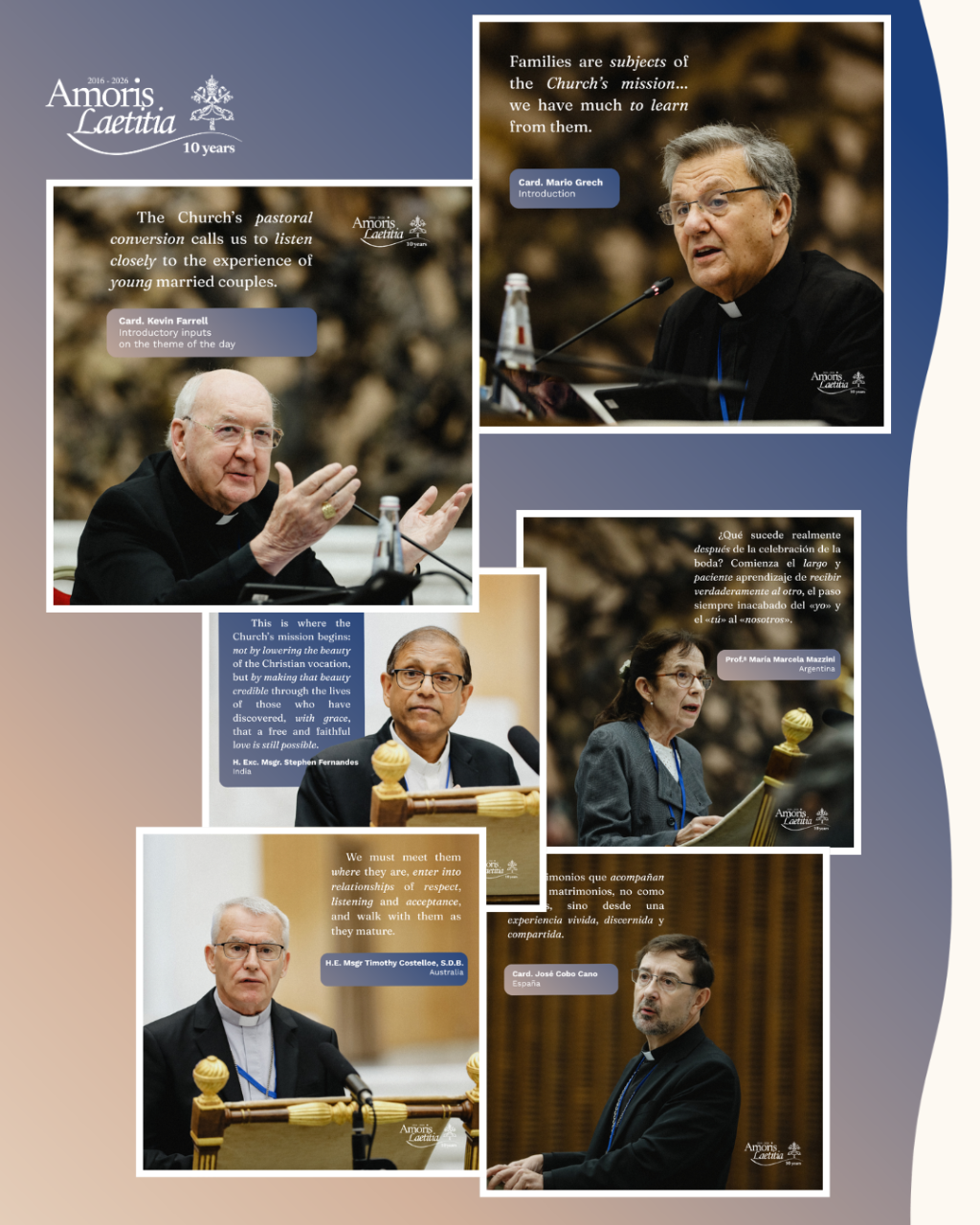
Introducing the day, Cardinal Kevin Farrell, Prefect of the Dicastery for Laity, Family and Life, did not shy away from the facts: the number of marriages, both civil and celebrated in the Church, is declining throughout the world. Yet beneath the statistics he posed a deeper question, whether God has perhaps ceased to speak to the hearts of young people, stirring in them a desire for marriage, inviting the assembly to look for signs of hope and for the spaces, initiatives and people that can open new paths towards marriage.
Mgsr.Timothy Costelloe, SDB, Archbishop of Perth (Australia), drawing on his experience as a bishop and educator, cautioned that to speak of “young people” risks treating them as a uniform group rather than as individual persons, so there are no easy answers or simple institutional solutions. The synodal journey, he observed, is less about structures than about a shift in the Church’s culture, the “style” Pope Leo XIV has called for: a culture of engagement and accompaniment that meets the young where they are, respects them and listens to them one by one. Where many doubt whether lifelong commitment is even possible, the witness of stable married couples, made visible and celebrated in local communities, becomes a powerful sign; and marriage preparation, he suggested, is better offered as an ideal to strive for than as a list of rules.
Bishop Stephen Fernandes, Auxiliary Bishop of Bombay (India), offered a complementary reading, beginning from the conviction that young people have not ceased to thirst for love: what has weakened, for many, is the confidence that love can endure. The challenge, he argued, is not to ask why young people fail to accept marriage, but what they are seeking when they speak of love, freedom, dignity and their future. Listening, he noted, allows us to distinguish between a rejection of marriage and a fear that lifelong committed love may no longer be possible, and the Church’s response must hold together truth and mercy. Taking the Emmaus account as a paradigm, he described a Church called to draw near, listen deeply, illuminate experience with the Gospel and help the young discern the next faithful step.
Saturday 10 October — Married life. The first years of marriage: a decisive time
Opening the fourth day, Cardinal Kevin Farrell recalled that, despite decades of effort to enrich marriage preparation, this is not always enough to help newly married couples deepen their conjugal love or face the difficulties that arise with the birth of children; nor does a period of cohabitation before marriage necessarily prepare couples better. The Church’s pastoral conversion, he said, calls it to listen closely to the lived experience of young married couples.
Cardinal José Cobo Cano, Archbishop of Madrid, placed a question before any new programme: do we truly understand, from the very start, the reality of the couples we want to accompany? The real issue, he suggested, is whether pastoral care is organised around the event to be celebrated, the wedding, or around the human, believing and vocational processes that unfold across a whole life: before courtship, during engagement and through the first years, when differences, children and change reshape everything. Here a key figure emerges, married couples who accompany other married couples, not as experts but from an experience lived, discerned and shared. At the heart of his reflection, an image that could stand for the whole day: we have to build a “we” without erasing the “I” and the “you”.
Prof. María Marcela Mazzini, Vice Dean of the Faculty of Theology at the Pontifical Catholic University of Argentina (UCA), developed precisely that theme, proposing that the first years of marriage be read as a true “mystagogy” of the sacrament celebrated: what is received on the wedding day is real and effective, yet asks to be understood from within and appropriated in daily life. She named the ordinary tensions through which couples learn their craft, communication and the handling of conflict, the organisation of a shared life, economic and life projects, and intimacy, which together form a system in which economic pressure, overload, resentment and communication feed into one another. The conjugal “we”, she recalled, does not appear automatically: a crisis does not necessarily mean the bond has vanished, but often that a particular way of living the “we” has entered into crisis. And if the bond is sacramental, ordinary life becomes a theological place, in the forgiveness that costs, the conversation that begins again, tenderness recovered and care given.
Across both days, the morning sessions were followed by work in groups using the method of Conversation in the Spirit, and, in the afternoons, by moments of open exchange among the participants on the basis of the rapporteurs’ reports.
Opening the Saturday session, Cardinal Mario Grech invited the assembly to pray for all those affected by the earthquake in Panama, and expressed his good wishes to the new Dean of the College of Cardinals, the Filipino Cardinal Luis Antonio Tagle. With the fourth day concluded, Sunday offers the participants a time of rest, before the Meeting resumes its journey through the themes that will guide the discernment of the days ahead.