

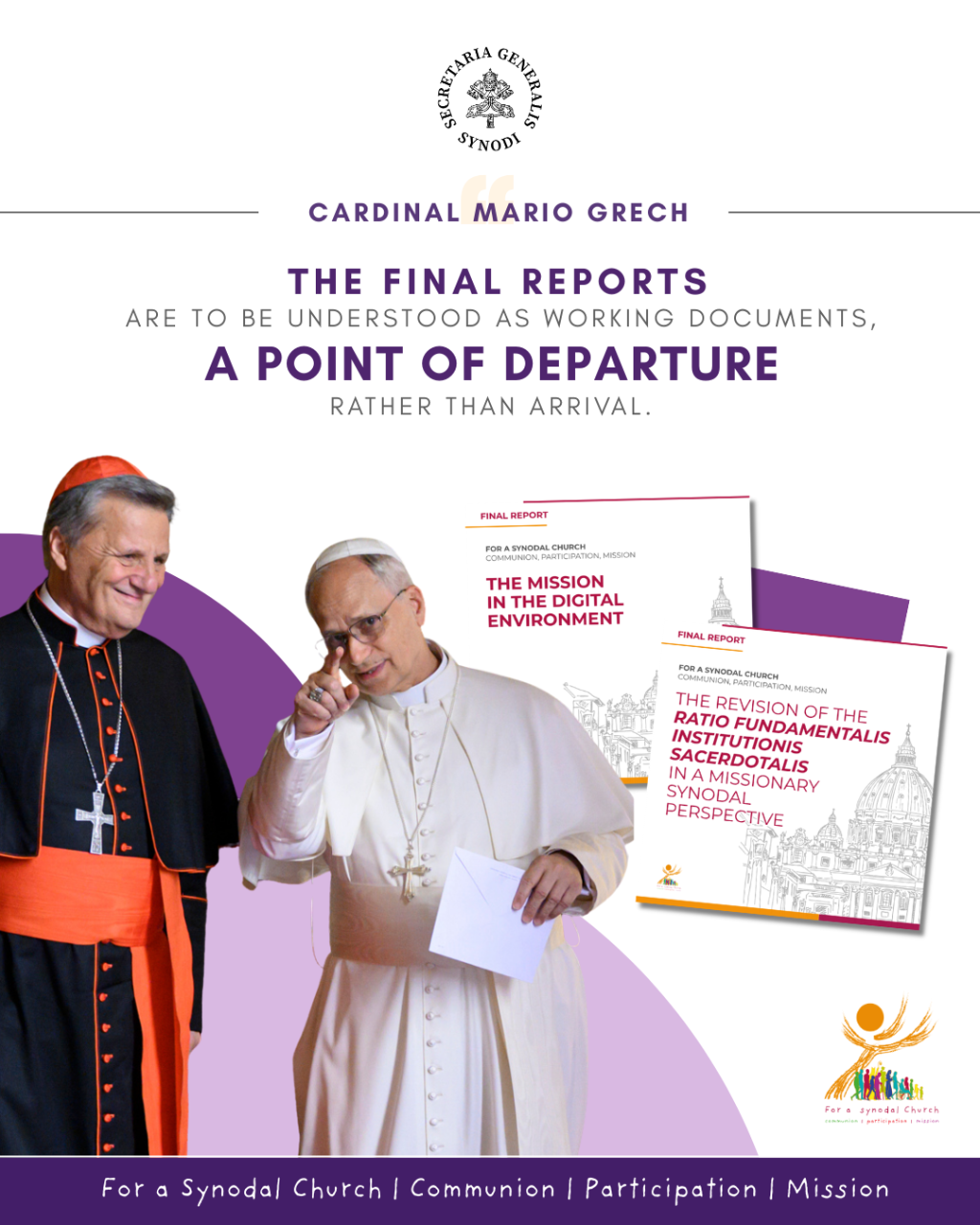
The first two Final Reports of the Study Groups published
Vatican, 3 March 2026
The General Secretariat of the Synod today publishes the first two Final Reports of the Study Groups established by Pope Francis following the First Session of the XVI Ordinary General Assembly of the Synod of Bishops: that of Study Group No. 3 on The mission in the digital environment and that of Study Group No. 4 on The revision of the Ratio Fundamentalis Institutionis Sacerdotalis in a missionary synodal perspective.
Pope Leo XIV has directed that the Final Reports be made public in order to share with the entire People of God the fruit of the reflection and discernment undertaken, thereby giving concrete expression to one of the essential characteristics of the synodal Church: transparency and accountability (cf. FD, no. 97).
“Beyond the value of their content, these Reports testify to the shared journey undertaken with the Dicasteries. It is not the first time that the Dicasteries have collaborated on a common project, but here there is something more: an authentic exercise of shared listening, reflection and discernment. It is synodality put into practice, not merely bureaucratic cooperation,” states Cardinal Mario Grech, Secretary General of the Synod.
The Report on the mission in the digital environment (Group No. 3)
The Report addresses a central question that emerged during the XVI Assembly: how to live the Church’s mission within a culture increasingly shaped by the digital sphere. Drawing on a broad consultation involving pastoral workers, experts and ecclesial realities from all continents, the Study Group gathered experiences, analysed challenges and formulated concrete recommendations.
Among the key themes: the need to integrate digital mission into the Church’s ordinary structures; an in-depth analysis of territorial jurisdiction in light of online communities; and the formation of pastors and pastoral workers in digital culture. The Report concludes with a series of operative proposals articulated at three levels – the Holy See, Episcopal Conferences and dioceses – and includes an extensive section on the methodology adopted and the entities consulted.
The Report on formation to the priesthood (Group No. 4)
Rather than proceeding with a revision of the Ratio Fundamentalis Institutionis Sacerdotalis (2016), judged still valid in its fundamental principles, Study Group No. 4 chose to elaborate a “Proposal for a Guiding Document” for its implementation in a missionary synodal key, in light of the indications of the Final Document of the XVI Assembly.
The document is structured in two parts. The Preamble offers an ecclesiological-pastoral framework and identifies a series of necessary conversions in priestly formation: relational, missionary, towards communion, towards service, and towards a synodal style. At its heart lies a central insight: the identity of the priest is formed “in and from” the People of God, not in separation from it.
The Guidelines, in the second part, translate these conversions into concrete operative pathways. Among the most significant proposals: alternating residence between the seminary and parish communities or other ecclesial contexts; shared formative experiences and moments with lay faithful, consecrated persons and ordained ministers beginning from the propaedeutic stage; the inclusion of qualified and competent women as co-responsible at all levels of formation, including within formation teams; and the acquisition of skills for co-responsibility and communal discernment. The Group also proposes a pathway for the dissemination and implementation of the operative directions offered.
Cardinal Grech further underlines that “the Final Reports are to be understood as working documents, a point of departure rather than arrival. Yet, even as working documents, they already contain valuable indications – as demonstrated by the Reports of Groups No. 3 and No. 4 – from which local Churches and various ecclesial realities may draw inspiration from this very moment. This is the spirit of synodality: a journey that does not come to a halt, in which each stage is already generative. It now falls to the General Secretariat of the Synod, together with the competent Dicasteries, to translate what has emerged in the Reports into operative proposals for the whole Church to be submitted to the Holy Father.”
Publication details
The Final Reports are published in English and Italian, with indication of the original language and of the working translation. A summary, available in various languages, accompanies each Report to facilitate access. With the presentation of their Final Reports, Study Groups No. 3 and No. 4 conclude their mandate and are therefore to be considered dissolved.
Note of the General Secretariat
Together with the Final Report of Study Group No. 3, the General Secretariat publishes a Note outlining the origin and mandate of the Study Groups, the nature of the Reports and the envisaged operational follow-up.
Next Steps
The General Secretariat will publish the Final Reports progressively. The next publication is scheduled for 10 March 2026.
------
To the Final Reports and executive summaries.
To the Note of the General Secretariat in ENG - ESP - FRA - ITA - POR
To the News Release in FRA and POR