
The fifth and sixth days of the Meeting “Ten years after Amoris laetitia: proclaiming the Gospel with families today” (Vatican, 7-14 October 2026)
The fifth and sixth days of the Meeting that gathers the Heads of the Eastern Catholic Churches and the Presidents of the Episcopal Conferences brought the work to its final two themes: accompanying families in the difficulties of life, and the missionary vocation of Christian families themselves.
Monday 12 October — In the difficulties of life: accompanying and supporting
Opening the day, Cardinal Kevin Farrell, Prefect of the Dicastery for Laity, Family and Life, recalled that, in the face of the fragility experienced by families, Amoris laetitia invited the Church to give priority to listening, to avoid judging too quickly, and to allow itself to be surprised by the action of God’s grace in people’s lives. Avoiding any spirit of controversy, he invited the assembly to speak truthfully about its own experience and to continue along the path of mercy opened by Pope Francis after the Synod on the Family.
Cardinal Pablo Virgilio David, Bishop of Kalookan (Philippines), shared the experience of his local Church. What first appears as an irresponsible or dysfunctional family, he observed, can look very different once we enter the home and listen to its story. The fragility of many families is not produced only by personal choices: family life can also be wounded by poverty, migration, violence, addiction, imprisonment, injustice and precarious work. This is why Amoris laetitia has been so important: it does not ask us to abandon the ideal, but to accompany real people in the often painful distance between the ideal and their situation. The first response, he recalled, was not a programme but a presence, summed up in a simple instruction to his missionaries: listen, dialogue, be present. For “accompaniment is not merely what a priest or pastoral worker does for a family. It is what the Christian community gradually learns to become around that family.”
Prof. Julie Hanlon Rubio offered a complementary reading. Search online for “a couple looking…,” she noted, and you will find countless images of a couple gazing at each other; it is far harder to find a couple looking outward, yet this is precisely what Amoris laetitia proposes, an intimate partnership committed to something larger. In 2026, marriage and family are becoming fragile in new ways, with a deeper fragility beneath, often felt as unworthiness and unreadiness. Fragility, she suggested, is both a crisis and a feature of our humanity, and the vision the Church communicates need not be one of perfection: whether single or married, with or without children, divorced, widowed or remarried, people can be met “at the door with open arms” and assured they are not alone.
Tuesday 13 October — Christian families as subjects of the Church’s mission
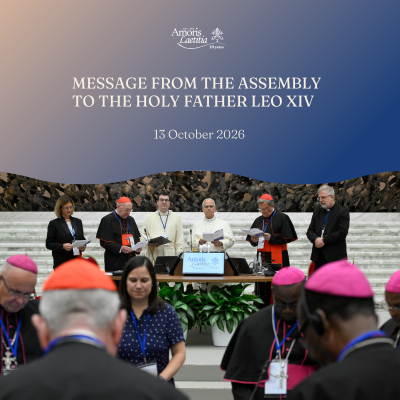
The final thematic day opened with a moment of deep communion. As Pope Leo XIV entered hospital that morning, Cardinal Mario Grech read, on behalf of the assembly, a message to the Holy Father expressing “our closeness and our affection.” Accompanying him with prayer and wishing him a swift recovery, the participants thanked the Successor of Peter for having wanted this Meeting and for encouraging them to listen to families and to the journeys of their Churches: “As we continue our work, we feel your closeness and carry with us your concern for families throughout the world.”
Introducing the theme, Cardinal Kevin Farrell returned to the missionary foundations of conjugal and family love. Through their lived faith, he said, families can bring the tenderness of Christ to those who are alone or whose lives have been marked by fragility and hardship.
Cardinal Protase Rugambwa invited the assembly to look at Christian families not simply as recipients of the Church’s pastoral care but as active subjects of her mission. After ten years of Amoris laetitia, he asked, what have we learned about the missionary agency of couples and families themselves? The family, he observed, has emerged as a true crossroads of all pastoral ministry, where generations meet, values are transmitted, faith is lived and the future of persons and society is shaped. From this he drew a pointed question: in these ten years, have couples and families been given a more active role in the formation of seminarians, deacons and other pastoral workers? He offered the African experience of the Church as family, and the reality of Small Christian Communities, as a living model for mission.
Mme Véronique Lonchamp developed the same conviction. Christian families, she recalled, are not merely recipients of pastoral care but “the principal agents of family ministry”: their contribution lies first of all not in what they do but in what they are. When daily life becomes a place where the Gospel takes flesh in relationships, gestures and trials, families make visible the love of Christ for his Church, and this is their first mission. The family, “a vital cell for transforming the world,” radiates well beyond the home, into places of life, work and commitment, even where the Church is little present. If families are truly active subjects of the mission, she concluded, the question turns back on the Church itself: the issue is not only what the Church can do with them, but what the Church receives from them, for when families are recognised as true agents of mission, they help the Church to become more synodal, missionary and attentive to people.
Across both days, the morning sessions were followed by work in groups using the method of Conversation in the Spirit and, in the afternoons, by open exchange among the participants on the basis of the rapporteurs’ reports.
With the five thematic days now concluded, the Meeting moves towards its final moments, carrying in prayer the Holy Father and the families of the whole world.